
RSIPF Drone Support Unit Strengthened through Exchange Program with New Zealand
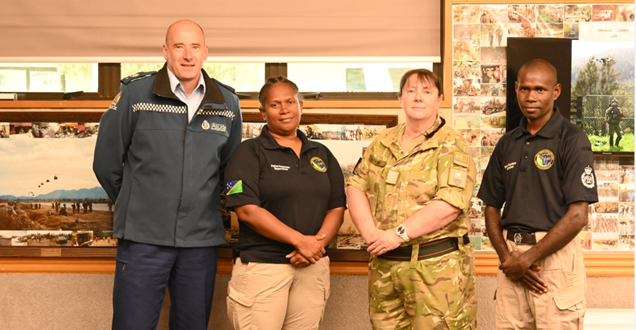
Left to Right: Bevon Cranstoun, Molly Puiaraha, Lisa Watkins, Andrew Pitakoe
A delegation from the Royal Solomon Islands Police Force (RSIPF), supported by the Australian Federal Police (AFP) through the RSIPF & AFP Policing Partnership Program (RAPPP), recently completed a landmark exchange training and research program in New Zealand to enhance the capabilities of the RSIPF’s Drone Support Unit (DSU).
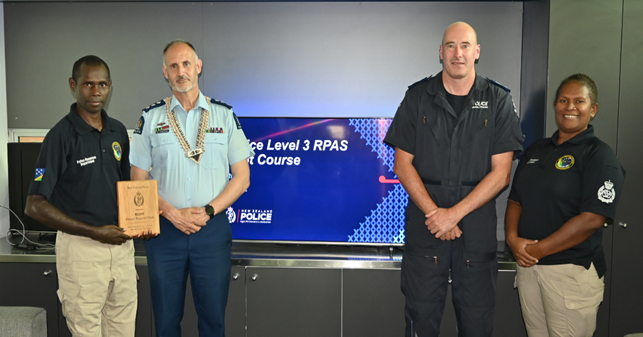
The program, which ran from 16 to 28 November 2025, saw two RSIPF drone pilots, Sergeant Molly Puiaraha and Police Constable Andrew Pitakoe, participate in an intensive series of training sessions, workshops, and collaborative engagements. The initiative aimed to expand the RSIPF’s operational and technical capabilities in unmanned aerial systems (UAS), in line with international best practices and regulatory standards.
During their time in New Zealand, the RSIPF team visited a range of key institutions and agencies, including Lichon University in Christchurch, where the New Zealand Police’s Level 3 Drone Operator’s Course was held. They also engaged with military and defence services, including the New Zealand Army’s Burnham Military Camp, the Royal New Zealand Navy in Davenport, and the Royal New Zealand Airforce in Auckland. These interactions allowed the RSIPF pilots to gain firsthand experience of New Zealand’s advanced drone capabilities and its integration into policing and defence operations.
The exchange program provided RSIPF pilots with the opportunity to:
• Participate in a Level 3 Drone Operator’s Course, focusing on advanced operational training, legal obligations, and technical standards under Civil Aviation Authority regulations.
• Observe cutting-edge training in 3D mapping, thermal imaging, and scenario-based exercises.
• View demonstrations of unmanned aerial systems (UAS) by the New Zealand Defence Force (NZDF), including fixed-wing and quadcopter technologies, which have been successfully applied in reconnaissance, disaster response, and law enforcement.
• Learn about New Zealand's Civil Aviation Authority’s (CAA) leadership in unmanned aviation and its risk-based approach to regulatory oversight.
A key focus of the exchange was to strengthen inter-agency relationships and build long-term collaborative networks. The RSIPF pilots had the opportunity to engage with New Zealand Police, Defence Force personnel, and Civil Aviation Authority experts, deepening their understanding of the operational and regulatory landscape for UAS in law enforcement.
The program also explored critical issues such as public trust, privacy concerns, and the broader societal implications of police drone operations. These discussions will help inform future RSIPF drone operations, ensuring they are aligned with both national and international standards.
The exchange program has delivered significant outcomes for the RSIPF DSU, including:
• Enhanced RSIPF drone capabilities through exposure to best practices and cutting-edge technologies.
• Strengthened governance and operational readiness within the RSIPF DSU.
• Expanded professional networks with key New Zealand government, police, and defence agencies.
• A deeper understanding of the integration of UAS into complex operational environments, improving the RSIPF’s ability to respond effectively to a range of policing challenges.
The success of the exchange would not have been possible without the invaluable support of key individuals and organisations. Advisor Pete Young, along with Superintendent Dave Williams of the RAPPP National Operations Portfolio, provided essential strategic guidance and engagement throughout the program.
Special thanks are extended to Inspector Darren Russell and Senior Sergeant Bevon Cranstoun of the New Zealand Police Aviation, Maritime and Border Tactical Operations for their professionalism, support, and friendship. Their dedication ensured that the RSIPF delegation felt welcome and well-supported during their visit.
Further appreciation is extended to Squadron Leader Carl Smith of the New Zealand Air Force, who played a key role in facilitating briefings and practical demonstrations across the tri-services Unmanned Aircraft divisions.
This exchange program represents a significant step forward in the professionalisation of the RSIPF DSU. The knowledge gained, along with the strengthened partnerships, will be critical in ensuring the RSIPF is equipped to meet the evolving demands of modern law enforcement, particularly in aerial surveillance and response.
The RSIPF remains committed to building a sustainable and effective drone capability, with the ultimate goal of improving public safety and security in the Solomon Islands.
Related resources

Media contact information
RSIPF Media Unit
Rove Police Headquarters
Rove, Honiara
Solomon Islands
Phone: 24016 or 23800 Ext 239
Email: rsipf.media@rsipf.gov.sb